
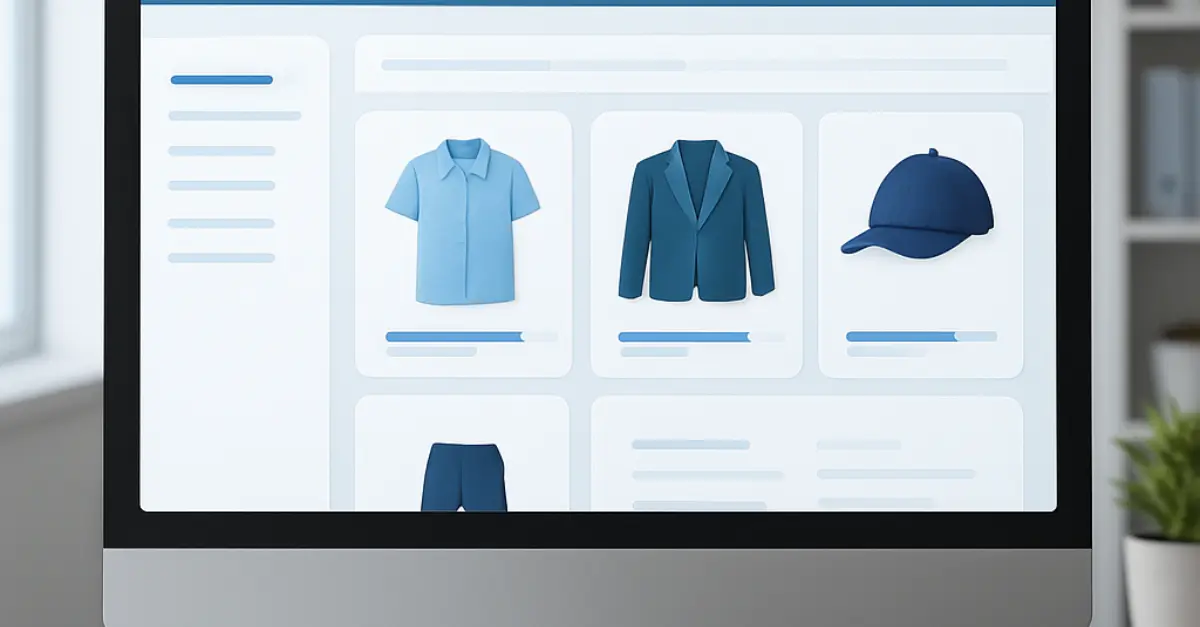
A uniform management system plays a critical role in organizations where uniforms are required for safety, brand consistency, or operational standards. As workforces grow and expand across locations, managing uniforms manually becomes increasingly inefficient, error-prone, and costly — and the gap between what's needed and what manual processes can deliver widens with every new hire and every new site.
Choosing the right uniform management system is not just a technical decision — it's a strategic one that directly impacts employee readiness, inventory costs, and the day-to-day workload of your HR and operations teams. The wrong choice leads to limited scalability, poor adoption, and ongoing administrative overhead. The right choice becomes a long-term operational asset.
This guide outlines exactly what to look for when evaluating a uniform management system, the mistakes organizations commonly make during selection, and how to ensure the platform you choose supports your workforce today and as it grows.
What Is a Uniform Management System?
A uniform management system is a centralized software platform that automates and manages the full lifecycle of employee uniforms — from initial entitlement assignment through distribution, tracking, renewals, and returns. It connects employee data, entitlement rules, inventory, and distribution workflows into a single controlled environment.
A modern system typically covers:
- Role-based and location-based uniform entitlements
- Employee size management and self-service updates
- Real-time inventory tracking by item, size, and fulfillment location
- Collection scheduling and booking workflows
- Alteration, return, and renewal handling
- Audit logs and compliance reporting
- Integration with HR and ERP systems
The goal is to eliminate manual coordination while maintaining the accuracy, transparency, and control that large organizations require.
Key Factors to Consider When Choosing a Uniform Management System
1. Entitlement Flexibility
Entitlement rules are the foundation of any uniform management system. The platform must support role-based and location-based entitlements, with configurable quantities, item types, and renewal cycles. Crucially, these rules should be applied automatically — when an employee is hired into a specific role, their entitlements should be pre-configured without manual intervention from HR.
Look for systems that can handle complex rule sets: different entitlements for part-time versus full-time employees, seasonal adjustments, probationary periods, and role change transitions. Rigidity here creates ongoing administrative work.
2. Employee Self-Service
A system without a self-service employee portal shifts every interaction onto HR. Employees should be able to view their entitlements, update their sizes, book collection appointments, and track their own uniform history — without raising a ticket or sending an email.
accumulate.
3. Real-Time Inventory Visibility
Inventory management and uniform distribution are inseparable. A system that tracks entitlements but not stock levels leaves procurement teams flying blind. The right platform provides real-time visibility into stock by item, size, and location — with low-stock alerts that trigger before shortages affect fulfillment.
This visibility also improves procurement decisions. Rather than ordering based on historical guesses, teams can see exactly what's been issued, what's been returned, and what's genuinely needed — reducing both overstocking and emergency reorders.
4. Multi-Location Support
If your organization operates across multiple sites, cities, or countries, the system must provide centralized control with local execution. Administrators need a single view across all locations, while site-level managers configure their own capacity, working hours, and appointment availability.
Systems that require separate instances per location create data silos and increase administrative complexity. Look for true multi-site architecture — one platform, one dataset, configurable per location.
5. Booking and Distribution Management
Unmanaged uniform collection — where employees arrive without appointments — overwhelms fulfillment staff and degrades service quality. A built-in booking system allows employees to schedule their own collection slots within administrator-defined capacity windows.
The system should factor in site-specific working hours, staff capacity, public holidays, and blackout periods. Employees see only slots that are genuinely available, and fulfillment teams can prepare for each appointment in advance — reducing errors at the point of handover.
6. Reporting and Auditability
In regulated industries, the ability to produce an accurate compliance record on demand is not optional. The system must log every transaction — issue, return, exchange, cancellation — with timestamps, user IDs, and item details.
Beyond compliance, strong reporting gives operations teams the insight they need: which items are moving fastest, which sizes are consistently short, which sites are running above or below expected distribution volumes. This turns uniform management data into actionable operational intelligence.
7. Integration Capabilities
A uniform management system that operates in isolation from your HR platform creates double-entry and synchronization problems. When an employee joins, changes roles, or leaves, their uniform entitlements should update automatically — not through a manual process that's easy to miss.
Look for proven integration with common HRIS platforms, as well as flexible API access for custom integrations with ERP or procurement systems.
Common Mistakes to Avoid
Organizations evaluating uniform management systems regularly fall into the same traps:
- Choosing generic inventory software — Standard inventory tools lack the entitlement logic, self-service portals, and booking workflows that uniform management requires
- Underestimating entitlement complexity — Simple systems that handle basic assignments struggle with the rule variations that real workforces require
- Ignoring employee experience — A system that HR loves but employees find difficult will see low adoption and poor data quality
- Selecting for current scale only — A platform that works for 500 employees but can't scale to 5,000 is a short-term solution that creates a future migration problem
- Overlooking reporting depth — Weak audit trails and limited reporting become significant liabilities as compliance requirements tighten
How Uniflow Meets These Requirements
Uniflow is a purpose-built uniform management system designed for the real-world complexity of large, distributed workforces. It was built specifically for organizations where uniform management is a core operational function — not an afterthought.
The platform provides automated entitlement logic, multi-location inventory control, employee self-service portals, booking and scheduling management, size history and alteration workflows, HR system integration, and real-time dashboards — all in one unified system.
Uniflow currently manages uniforms for over 20,000 employees across aviation, hospitality, and transportation organizations, processing hundreds of thousands of transactions with full traceability. It adapts to your organizational structure, whether you manage hundreds of employees at a single site or tens of thousands across multiple countries.
Conclusion
Selecting the right uniform management system is about more than technology — it's about control, efficiency, and long-term operational confidence. The platform you choose will shape how your HR team works, how your employees experience uniform management, and how prepared you are for compliance scrutiny.
By choosing a system built for automation, transparency, and scale, organizations reduce costs, close compliance gaps, and deliver a consistently better experience across the workforce.
Talk to the Uniflow team to see how the platform handles your specific entitlement rules, locations, and scale — and how quickly you can be up and running.