
Introduction
Most of the difficulty in uniform management is not choosing a system. It is the three months after — the stretch where entitlement rules have to be written down for the first time, sizing data turns out to be five years stale, and a distribution team that has run on spreadsheets and goodwill is asked to work a different way.
This is the part that gets skipped. Organizations run a careful evaluation, pick a platform, and then treat go-live as a switch to be flipped. It rarely goes well, and when it does not, the conclusion drawn is usually that the software was wrong rather than that the rollout was.
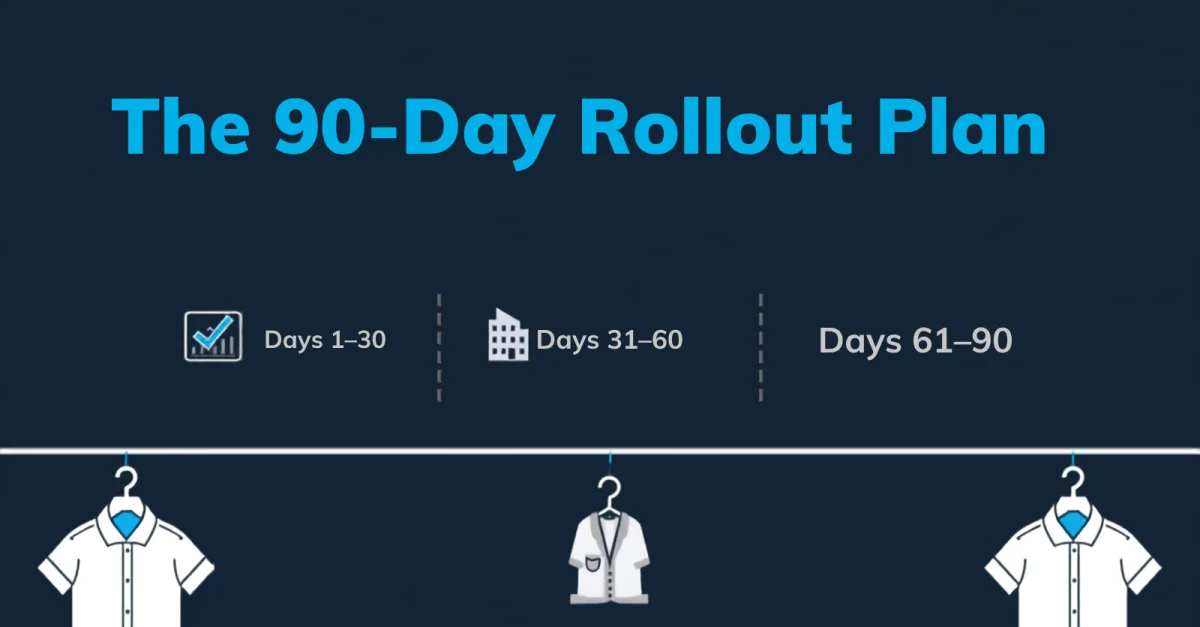
What follows is a 90-day plan that has held up across aviation, hospitality, healthcare and industrial deployments. If you have not chosen a platform yet, start with how to choose the right uniform management system and come back to this once that decision is made.
Before Day 1: Decide Who Owns It
The single best predictor of a smooth rollout is whether one named person owns the outcome. Not a committee, and not "HR and procurement jointly" — one person with the authority to settle entitlement disputes without escalating.
This matters because a uniform system forces decisions that were previously avoidable. How many shirts does a supervisor get in their first year, as opposed to their third? Does a transfer between sites reset the entitlement clock? Who approves a replacement for an item that was lost rather than worn out? These questions have been answered informally, case by case, for years. A system requires one answer, written down.
If that role does not exist in your organization yet, what a uniform manager actually does is a useful starting point for scoping it. In smaller operations it is often a portion of an existing procurement or HR role rather than a new hire.
Days 1–30: Get the Data Right
Nothing else in the rollout matters if this phase is rushed. Every failure mode later in the project traces back to data that was imported before it was correct.
The employee roster
Pull the roster from your HR system rather than from whatever list the uniform team has been maintaining. Expect a gap between the two — leavers who were never removed, contractors who were never added, and people whose role changed without anyone telling the uniform store. Reconciling those two lists is often the first time anyone has seen the real headcount by role and location.
Entitlement rules
Write the rules out explicitly, by role, before configuring anything. The useful discipline here is to express each rule as quantity, replacement interval, and the condition that triggers an exception. Role-based entitlements covers the modelling in depth, and automated uniform allotment goes through the patterns that hold up once they are running unattended.
Two rules of thumb. First, resist the temptation to encode every historical exception — most are precedents nobody would defend if asked directly. Second, if a rule cannot be stated in one sentence, it is probably two rules.
Sizing data
Assume it is wrong. Sizing records are usually captured once at onboarding and never revisited, and bodies change. Importing stale sizes produces a first distribution cycle full of exchanges, which is the fastest way to lose the workforce's confidence in a new system.
The cheap fix is to collect sizes through self-service before go-live rather than after. Employees confirm or correct their own record, which is both more accurate than a five-year-old spreadsheet and considerably less work than a manual re-survey. Self-service portals covers why this holds up better than administrator-maintained records.
Opening stock
Count what you actually have, by item and size, at every location. This is tedious and routinely postponed, and it is the baseline every later inventory number depends on. Without it you cannot tell whether a shortage three months in is a demand spike, a distribution error, or shrinkage that predates the system. Managing uniform inventory goes further into the counting discipline.
Days 31–60: Pilot One Site
Run the first cycle at a single location. Not the largest, not the most cooperative — pick one that is representative enough that its problems will also be the other sites' problems.
The purpose of a pilot is not to prove the software works. It is to find out which of your entitlement rules are wrong, and that only surfaces under real distribution volume. Expect to revise rules during this phase; that is the pilot succeeding, not failing.
Four things worth measuring from day one:
- Exchange rate. What proportion of issued items come back for a size change? Above roughly one in ten and your sizing data still needs work.
- Time per collection. From the employee arriving to leaving with their items. This is the number the workforce actually experiences.
- Exception volume. How often does a distribution require someone to override the rules? A high rate means the rules do not match how the operation really runs.
- Stock accuracy. System count against physical count at the end of the cycle. Divergence here early is much cheaper to investigate than divergence at scale.
Turn on verified collection during the pilot rather than adding it later. Retrofitting an audit trail onto a process people have already learned is harder than starting with it, and the pilot is where you establish that every issued item is logged against a person. Verified distribution covers the mechanics.
Days 61–90: Sequence the Wider Rollout
Resist a single cut-over across all sites. Sequence them, and let each group start from the corrected rules and cleaned data the pilot produced.
Order sites by a combination of size and difficulty: something small and straightforward first to build the team's confidence, then progressively harder cases. Sites with unusual entitlement structures — seasonal operations, mixed contractor populations, anything with a separate safety-equipment regime — belong last, once the pattern is established.
For multi-site operations the coordination questions become real at this stage: which site's stock covers a shortage elsewhere, who can see what, and how transfers are recorded. Distribution across multiple locations covers the structures that work.
Plan support around the first cycle at each site rather than around the go-live date. The questions arrive when people collect, not when the system is switched on, and they concentrate in the first two weeks of real use.
Where Rollouts Actually Fail
Four failure modes account for most of the trouble, and none of them are software problems:
- Importing stale sizing data. Produces an exchange-heavy first cycle and lasting scepticism about the system's accuracy.
- Leaving entitlement ownership unassigned. Every edge case becomes an escalation, and the backlog of unanswered questions stalls the rollout.
- Skipping the opening stock count. Makes every later inventory discrepancy unattributable.
- Big-bang cut-over. Guarantees that any rule error is discovered everywhere at once, when it could have been found at one site.
The common thread is that all four are decisions made before go-live that only become visible afterwards, which is exactly why the first thirty days deserve more time than they usually get. The hidden costs of poor uniform management covers what these look like when they are left to run, and the challenges large organizations face covers the structural versions of the same problems.
What Success Looks Like at Day 90
By the end of the first quarter you should be able to answer, without anyone compiling a spreadsheet: how many items were issued last month and to whom, which sizes are running short, which employees are due for replacement in the next cycle, and what the exception rate is by site.
That last point is the real test. A rollout has worked when the reporting is a by-product of normal operation rather than a separate exercise someone performs on request. Real-time visibility covers what that reporting layer should give you.
What you should not expect at day 90 is that entitlement rules have stopped changing. They will keep moving as roles change and the operation evolves. A system that makes those changes cheap is working correctly; the goal was never to freeze the rules, only to stop them living in people's heads.
Conclusion
A uniform management rollout is mostly a data and decision-making exercise with a software deployment attached. The organizations that find it painless are the ones that spent the first month on entitlement rules and sizing accuracy instead of on configuration screens.
If you are planning a rollout and want to talk through the sequencing for your sites, get in touch — we have run this with organizations from a few hundred employees to well over twenty thousand.